
Hey, it's Nathan. Welcome to Human Systems 101 Sef-Study. In this first section, you'll learn our specific and rigorous definition of 🌳 Personal Values as well as how to separate them from fuzzy concepts, goals, and expectations. This is the foundation of values-based design. You won't be able to proceed without it. As a warning, this class teaches you skills. Getting good at them is going to be hard work. But as you saw in the kickoff, it's worth it. See you in the dojo!
Check your progress as you go: [approx. 2.5hrs]


What do you mean by "value/values"?
People have deeply different ideas about the words "value" and "values". Before going deeper into the Human Systems design method, you'll need clear definitions. Outline your current understandings so you can ask the right questions later. It's ok to have multiple and/or contradictory ideas. Even if you just have a vague notion, it's useful to write it down!
Brain-dump/stream of consciousness: What does "value" mean? What does "values" mean?
Hint: you may have lots of concepts about values: corporate values, money and expensive things, moral virtue, etc... Write down everything that comes to mind.

What are 🌳 personal values in Human Systems?
In Human Systems, a "personal value" refers to two things: an experience and a phrase.
Personal value (experience): A personal value is an aspect of your perception, usually referred to as wisdom, inspiration, appreciation, or admiration. It's what makes your heart sing when you're following hard-earned wisdom and life is unfolding well. It's what you feel in your body when you appreciate the beauty of nature. It's what you see when you admire someone for the way they live. It's being inspired regarding how to handle a situation well. There are so many choices you could make as you move through the world. Personal values guide your attention down a path, and make the most inherently worthwhile choices stand out.
Note: This is one reason that non-values can be easily bundled up with personal values. Goals and expectations also guide your attention and make potential choices stand out.
Learn more about the experience of personal values and non-values:
Personal value (phrase): Building on what was said above... when you articulate the experience of a personal value in words, you capture patterns of appreciation, admiration, and wisdom regarding how to live well. This definition of personal values (clear, awareness-guiding, improvisational directives that, when followed, are meaningful in themselves) is what we will mean throughout the course. It is the foundation of good values-based designs.
Note: This is another reason that non-values can be easily confused with personal values. Unclear, outcome-oriented, fuzzy concepts are often also called "values".
Learn more about a rigorous definition of personal values:
Questions?
Your trainer will be available to answer them in the dojo. Write everything down that you don't quite understand, so you don't forget to ask.


A lot of what we do socially is aimed at controlling outcomes, meeting expectations, setting expectations, etc. We also want and expect things from ourselves. What people usually call "values" are actually broad concepts that bundle together values, goals, and expectations.
The short meditations below (about 10 minutes each) will help you start recognizing these confusions and "purifying" your values, separating them from goals and expectations.


This short reflection will help you to start to recognize the difference between expectations and personal values.
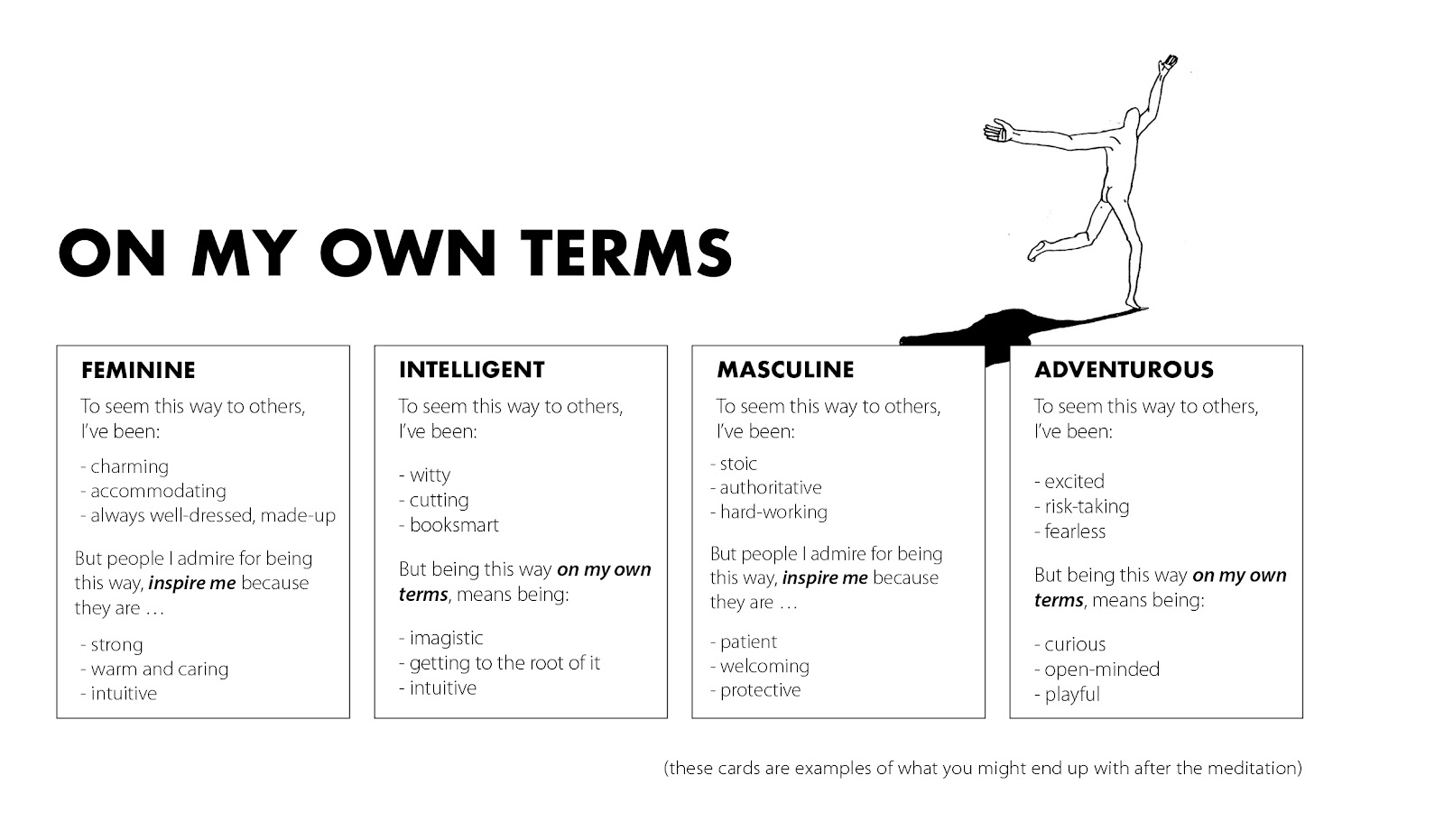


The experience of attention being guided by goals/expectations or values is quite different. Sorting out that difference in yourself trains your intuition to recognize confusions in others.


The real difference between expectations and values lies inside any word or concept. It's a matter of how things resonate with you (as a source of inspiration or pressure). You'll start to get a "feel" for the difference between social performance and personal values that will be the foundation of your values-based design skills.

Questions?
Your trainer will be available to answer them in the dojo. Write everything down that you don't quite understand, so you don't forget to ask.


Articulated personal values are the foundation of good values-based designs. So make sure your formulation is on point. Your personal value should be a clear, awareness-guiding, improvisational directive. These three critera interpenetrate, but you can find examples and help below.
Start by writing a pure personal value from one of your "on my own terms" answers:
approach things _____, treat people _____, act (with) _____, keep things _____, live life ______
Personal Value:


Value phrases can be too vague to be useful for design. Make sure your phrase names something specific enough that it could guide a person's choices.
Could a random person fully understand this if they just read it?
Make your value "clear" by asking these questions:
When you manage to live by your personal value, what are you noticing? What specific aspects of the situation should your personal value phrase bring into the foreground?
Use that information to rephrase your value in terms that anyone could understand:
approach things _____, treat people _____, act (with) _____, keep things _____, live life ______


Personal value phrases tell you how to approach a situation. They foreground relevant choices.
Does it tell me what I should be paying attention to right now?
Make your value "awareness-guiding" by asking these questions:
Where should you direct your attention in order to live by this personal value?
Use that information to rephrase your personal value and make those things stand out:
approach things _____, treat people _____, act (with) _____, keep things _____, live life ______


A value doesn't tell you what is going on or what to do about it. It's an improvisational directive that helps you recognize opportunities to be a certain way. Is your personal value phrase just an instruction? Or does your value remind you of how you'd like to approach a given social context?
With this in mind, do I get a feel for how to approach things?
Make your value an "improvisational directive" by asking these questions:
How would you tell an actor to approach a scene in which she lives by your personal value?
Use that information to rephrase your personal value to be more about how to proceed:
approach things _____, treat people _____, act (with) _____, keep things _____, live life ______


Emotions point at what is important to us. You might be joyful at the sight of an old friend, or angry when you feel some injustice has taken place. But upon reflection, our emotions are not only about external circumstances. They can also point us toward our values, “ways of being” that are important to us, and which were either expressed (tends to feel great) or suppressed (tends to feel crummy).
Learn more about the connection between emotions and values here:
Emotions, Values, and Wisdom[5 minute read time]
Try out one of the foundational skills of the Human Systems design method: Emotions to Values. Remember: Practice makes perfect. The more you practice the Emotions to Values method, the more deeply you will understand it. If your house isn't on fire, do it at least twice.
Method: Emotions to Values


Eventually, you'll be able to tell if a personal value is ready for the big time. For now, make sure it isn't bundled up with non-values and is phrased well for design purposes by running it through the values gauntlet.
Personal values need to be pure and articulated. You've have the skills, now put them to use!


Prepare for the 🥋 Dojo
You're almost ready for your first meeting with a Human Systems trainer. In your "dojo", you'll be able to ask questions and practice the techniques you've learned. This section will bring everything together to uncover other people's values in what we call "💡Epiphany Interviews".